Lynch's clue #10: Where is Aunt Ruth?
- First we see who we believe to be Aunt Ruth at 1612 Havenhurst: a well-dressed red-headed lady with a scarf on, and a taxi driver helping her with her bags.
- Then at the airport while Betty is saying goodbye to the old couple, who walks by around the taxi zone? A well-dressed, red-headed lady with a scarf on, and a man accompanying her, carrying her bags.
- And then at Sierra Bonita, Betty and Rita watch a well-dressed red-headed lady with what appears to be a scarf around her, with a man carrying her bags to a limo or towncar. — Visual Echoes: Accompanied red-head
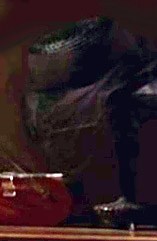
- There's a black hat in Aunt Ruth's bedroom. Is it part of a funeral outfit? Another clue to us that Diane's aunt is dead?
- Ruth is leaving Havenhurst (probably) towards LA airport to catch her flight for Canada where she's gonna shoot a movie. Betty just arrived at LAX from Ontario, Canada to go to Havenhurst. Why are they missing each other? Betty probably hasn't seen her aunt for a while, and Ruth leaves the very same day Betty arrives. They could have arranged their flights in order to meet at Havenhurst or even in LAX. Also, in the end we see Ruth arriving just after Betty has left. Betty's aunt is always just out of reach in Diane's fantasy. This is actually a glimpse on reality where Diane's aunt died before she moved over to L.A.
- Watch interpretations of Lynch's clue #10 here.
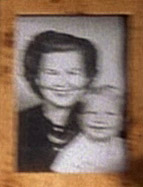
Searching for Aunt Ruth is a quest that Diane has been on since before she came to Hollywood. In fact, it probably started in earnest as things in her family fell apart after the abuse she went through. Aunt Ruth is her only notion of family anymore, as the picture of Aunt Ruth with Diane as she was a child in her fantasy seems to attest (Havenhurst interior). Yet, as we will see repeatedly, the Aunt Ruth of Diane's dreams never connects with Diane's various personas, as though she is just out of reach. And this represents a tragic truth that she cannot escape, that their lives never came to overlap in Diane's adulthood — Aunt Ruth died before Diane made it to Hollywood. And without Aunt Ruth, Diane has been afraid and alone, unable to find the right path on her own. — Alan Shaw
Again — where is Aunt Ruth?
This clue is really a rhetorical question. We are not supposed to name a location for Aunt Ruth, but to consider her entire existence. Whether or not you believe she really existed, certain things are undeniable:
- Aunt Ruth is linked to both Betty and Diane. We have to assume the aunt Diane refers to at the dinner party is Aunt Ruth, however perhaps the reason Diane does not actually name her may be because she is not really a real physical being.
- Aunt Ruth seems to be also more of a generic term for the many ladies we see packing and leaving in MD.
- As absent as the Aunt Ruths are in Diane's mind and Betty's visit, they are the closest we come to a realistic 'parental figure' in the movie. The Old Couple are way too old and creepy to merit the label of parental.
So I plead an agnostic on how real Aunt Ruth was. Many things point to there not really being a physical Aunty Ruth, however the idea of Aunt Ruth is a huge part of Diane's psyche. Aunt Ruth represents the mother figure Diane lacked. Those of us who feel Diane may have been sexually abused as a child consider that Aunt Ruth is a 'sanctuary' concept in Diane's mind, if not a real person. This is why her Aunt's apt is merely a dressed up version of Diane's own frumpy digs. Diane would not need to imagine her Aunt's luxury apt and leather couch if she had been there before. Diane may well have run away to LA to avoid sexual abuse and since she could not tell the guests at the dinner party that reason she invokes her 'sanctuary' Aunt as the reason for her visit — "When my aunt died — she left me some money" etc. So where is Aunt Ruth? In Diane's head mostly. — Thespear
Related Theory: Diane's dream is a replay of her sexual abuse
Aunt Ruth — the principal character?
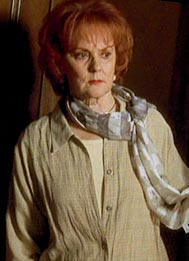
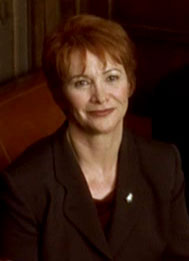
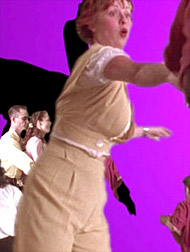
Betty/Diane is Aunt Ruth in her young years! It's her story. The movie is about a young girl who came from Canada to make a career in Hollywood. She was dreaming to become a famous actress, a movie star. It's Aunt's dream — that's why she had Rita Hayworth's poster on the wall — a movie star from the 50s. All the movies Adam is making are placed in the 50s/60s, also Ruth's and Diane's apartment are far from being modern (the bathroom, the fridge, the oven), the old-fashioned dance contest Diane wins… Note: there is a jitterbug dancer who seems to resemble Ruth in her younger years. She also sports a bracelet similar to Ruth's. The anachronistic touch of the women ride around in cabs. Also Camilla has always this dramatic look like movie stars in the 50s had — she never looks "modern." Coco and the Cowboy both seem like characters out of a forties B grade movie. Notice that in the first part there is no foul language: "horse pucky" and "smart aleck" are spoken in place of "horse shit" and "smart ass." Try to find a dirty word in the first part. Betty herself is kind of cheesy. She seems to be a bit naive for movie-making; even naive for life in general. She has the attitude of a little girl hoping good things will happen (much like the story of many feminist flicks of the 50s era). Why? There's no other reason in this insistence in the 50s. One more thing: Aunt makes her appearance when Betty disappears. Betty didn't leave the room, wasn't sucked by the blue box — she vanished to reappear as the Aunt! This is the clue: where's Aunt Ruth? The reality of Betty and Diane are probably the two possible ways her life could have been. — Aleksandra H.
To take it a step further, perhaps they are all representative of Ruth at different stages of her life: A young jitterbugger, into a stylish young actress (Betty), into a popular casting director (Linney James), to retirement (Lady at Sierra Bonita). — blu-riven
I think there is a strong sense that this film really spans multiple generations and times; maybe all lumped together in a "convoluted present" such as if someone might be remembering something from all of their past at the same time. If so, we might be looking at characters from the 50's, 60's, and 70's instead of the 2000's we believe the story is set. — tv-striker
While not quoting any particular film, Lynch uses the retro-'50s imagery to evoke media-memories of an 'innocent' America. It is the ideal pop culture iconography for his characters' dreams of purity and fulfillment, and thus equally ideal for subversion. This is definitely the case in Mulholland Drive — Betty/Diane was brought to Hollywood after winning a jitterbug contest and, from what we see of the film she wants to star in, it appears to be a '50s set romance with musical scenes. But the '50s was also the classic decade of film noir which, like Lynch, embraced such themes as paranoia and conspiracy, the constant questioning and subversion of accepted identity, the fragility of sound perceptions of reality when attacked by desire, guilt and/or curiosity as well as the fragility of fantasy and its attendant hopes. — sensesofcinema.com
The movie being made by director Adam is "The Sylvia North Story", and it seems to take place in the 60s. What I was surprised is why the blonde Camilla Rhodes (the one in Diane's supposed fantasy) is at the dinner at the film's conclusion wearing a sixties outfit when everyone else in the film seemed to be dressed modernly. In addition, when Betty and Rita go looking for "Diane," they see a woman in a 60s outfit with short blonde hair approaching the apartments carrying suitcases with a man in a suit. — Lucy Tonic
As emblematic figures of Hollywood, Diane Selwyn represents its young victim (the hopeful blond starlet struggling for her break), and Aunt Ruth the survivor. When Aunt Ruth Elms re-enters her apartment near the end of the film, she seems a very real character and not a product of Diane Selwyn's dreaming imagination; in fact, it is Ruth's arrival home that ends the film's dream sequence. Possibly this character is someone Diane met through her work in the movie industry, someone who has obviously been successful and loved (witness Ms. Elms' beautifully appointed apartment and many framed family photographs), and whom Diane has perhaps dreamt of patterning her own life after, or (in her dream?) having as an aunt. (Nowhere in the film does Diane say that her own aunt, who reportedly died and left her a legacy before she came to Hollywood, was named Ruth — only that she worked in the movie industry. And the fact that Diane does not mention her aunt by name when she is talking to Coco at Adam Kesher's dinner party suggests that this woman may not have been well known, or "important," in the industry.)
So, "Aunt" Ruth Elms the survivor, coming and going (representatively) in many scenes, whose career and life have no doubt taken several twists and turns, and who ends the movie's dream sequence by returning home, to her own bedroom, safe and sound (rather like Dorothy in The Wizard of Oz, and in stark contrast to Diane Selwyn, who lies a suicide victim in her bedroom at the end of the film). Is there meant to be some residual hope, some solidity for Hollywood in the character of Aunt Ruth? Yes, I think so. — E. V. Raymer
Trivia
Another interesting remark is that the actress playing Aunt Ruth, Maya Bond, is referenced for nothing else than Mulholland Dr. on IMDb. I think that Lynch has chosen a completely unknown actress to play Ruth's part just to match with the fact that it was a lie that Diane's aunt was 'in the movies'. Coco's and Ruth's social conditions are switched in Diane's dream. — gandalf36
- MAYA: Maya is the principal concept which manifests, perpetuates and governs the illusion and dream of duality in the phenomenal Universe. For some mystics this manifestation is real, but it is a fleeting reality; it is a mistake, although a natural one, to believe that Maya represents a fundamental reality or Truth. wikipedia.com
► Pun intended? — Aunt Ruth = untRuth - BOND:
- Something, such as a fetter, cord, or band, that binds, ties, or fastens things together
- Confinement in prison; captivity