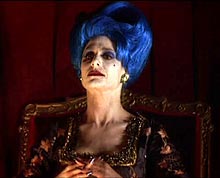
Club Silencio has another riddle to pose — the Blue-Haired Lady. Aloof in her "box" above the stage, she sits quietly but imperiously, garishly made-up and crowned with a bizarre head of electric blue hair. While neither her presence nor purpose are ever explained, her single line of dialogue brings the film to a close. She may be the mistress of Club Silencio, she may be a favored patron, or she may be an idealized form of the monster — especially if we see the monster as a minister of secrets, functioning as a merciless agent of self-realization. If Club Silencio is the universal image of Diane's personal blue box, its Blue-Haired Lady could be the Queen of Monsters. After all, both Lady and monster reappear in the last few minutes of the film. Perhaps "Silencio" is not only an artistic statement, but a Zen-like instruction as well, echoing the many mystical beliefs relating silence with wisdom and understanding. — Allen B. Ruch
She is the fourth reality in the movie, and that is the reality that is not the movie. The last images of the movie are from a blue-haired woman in the theater, reminding us that films are all illusions and that we should live our lives in the real world. Just as Diane's fantasies are filled with corny movie dialog and plot twists, just as she identifies with the movie star Camilla to the point of obsession, just as she loses everything trying to be a Hollywood actress, we too live in danger of seeing ourselves and our lives in relationship to the fictions of the movies and stars. The movie becomes a warning tale. Tune out the media and try, instead, "silencio." — David14
The Blue-Haired Lady a guardian?
The magician makes us believe in things that do not exist and in events that are not happening, and the Blue Lady reigns supreme over the magician and the stage: in the darkness of the balcony and nearly unseen, she owns the Club! At the end, the stage is empty, there is no magician and no audience and no sound, not even "recorded". Only she, still and silent, remains. And she is the one that utters the last command/word/sound. She does not represent death because she does not belong to this side, the only side where death happens and is real. For us she is the only "thing" that is not an illusion; she is the guardian of the real and as such of what is by nature forever inaccessible to us. If she feels so "creepy" to us, it's not because of what she may represent, but because we already know deep down as certain that she is the one we cannot go beyond, even after death, and that she, in her stolid silence, is the one that "knows" what we will never know.
The Blue Lady represents the vortexing but impregnable "closure" of "this side", of our space-time, outside of which we just are not. She represents the Unknown that surrounds us like a wall and from which we cannot escape alive or dead. She's horrifying because she's the palpable representation that, ultimately we know nothing and will never know what we most wanted — and needed — to know and, next to her, all we are and see and imagine to exist, is really "the stuff dreams are made on": the haze and smoke and silence that surrounds her mystery. — brazilnutfox
The Blue-Haired Lady = God?
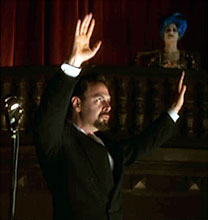
Why would Diane have her sitting up on the balcony like that? Diane's dream is full of images of people in 'high places.' Mr. Roque, the Castigliane Bros, the Cowboy (who even lives at the top of Beechwood Canyon). Throughout the dream there seems to be someone (or something) manipulating every event. The point of these images I think is to emphasize an important theme of Diane's fantasy: Nothing that has gone wrong in her life was her fault. Her tragedy was preordained by forces beyond her control. Having someone 'overseeing' the events at Silencio makes sense in that context. The blue-haired lady seems unique though, because she doesn't seem malevolent. She gets the last word of the film, "Silencio," and in saying it seems to pity Diane. I think Diane creates her as a sympathetic but powerless observer. Maybe she's Diane's idea of God, who can watch but not take part in human affairs, while the magician is her idea of Satan, who has more influence over people (he makes Betty shake). Considering the state of Diane's life, it makes sense that God is up in the background while Satan takes center stage at Silencio. — binaural485
I wonder if the blue-haired lady is a goddess motif. She presides over the events of Club Silencio without intervention, appearing to be moved by the plight of those observing their illusions fall away. This is further enhanced by the ending, which shows the idealized Betty and Rita together in complete and utter eternal happiness while the blue-wigged lady says "silence". Her blue hair is an indication that she is from the realm of the metaphysical, or representative of it, as that shade of blue is associated with the mystical. The blue box and key are therefore also metaphysical. — audrey'shoes
The Blue-Haired Lady = Camilla?
Is the Lady in Club Silencio portraying Camilla in her afterlife? Considerations:
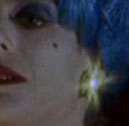
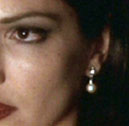
- There's another person uttering "Silencio" — Rita. She was the one who insistently repeated this word, which took the girls to the club. Apart from Rebekah Del Rio, Camilla is the only female character that we know speaking Spanish. And the movie ends with the same word said probably by the same person.
- Rita is wearing a blond wig — the Lady in Club Silencio a blue one. The colour blue provides an indication of the harsh reality that Diane tries to escape: Camilla's death. So the blue wig is connected to the blue key that the hitman left for Diane, indicating Camilla's death as well as the blue box that is found by Betty symbolizing the truth that finally will be unlocked.
- Camilla is dead — so it makes sense for her to sit in the balcony of Club Silencio looking down on everyone, similar to someone in heaven looking down.
- Also, the end of the movie would suggest she is an incarnation of Camilla/Rita because of the shining earring as the final scene fades out, echoing the missing earring the detectives found in the car after the accident.
- But the lady with the blue hair needs an old theater with a box seat that overhangs the stage to impart her particular truth. This is because her truth involves death, and in particular death by assassination. It was in a box seat like this, in a theater like this, that Abraham Lincoln — who had a prominent mole in the same place as the woman with the blue hair — was assassinated. To really understand this connection, we must remember that Diane's fantasy starts off with a scene that involves the attempted assassination of Rita. Rita survives that assassination because of an accident that was lucky for her, but her left ear is wounded and bloodied because her pearl earring was torn off. These details are significant due to the fact that Lincoln was shot right behind his left ear, and the gun was a small Derringer which some reports maintain had a white pearl handle. Moreover, the limousine that Rita was in at the time of the assassination attempt and accident was a Lincoln, even though the detectives who later investigate the scene call it a "Caddy." Like the magician before her, the woman with the blue hair shows up to uncover a reality that Diane has repressed. Camilla, like Lincoln, did not survive the assassination attempt. So the implication is that Rita's miraculous survival is just yet another misleading illusion. — Alan Shaw
The Blue-Haired Lady = Aunt Ruth?
- I believe it makes perfect sense that she is Aunt Ruth. The reason for her blue hair can be explained. The club's interior is almost all red, just like her hair, but you'll notice that the club sometimes is flooded with strange blue light. As Aunt Ruth has the only balcony seat, we can assume that she holds a special place in the club, and therefore her hair has turned from red to blue (she has been tainted with the guilt of silence). The absence of her scarf could indicate that she has been stripped of her pride which forced silence upon Diane. Also, it would be a dead giveaway that she was Aunt Ruth if she wore a scarf. Lynch is far too abstract for that. — Mark Beers
- People suggested that Diane was abused by her Uncle when she was younger, and her aunt, having found out about her husband and Diane, went to her death bed without mentioning it to anyone ("Silencio") and thus made it to hell. (→ Hell sign) So where is Aunt Ruth? We think she could be in hell. When we twin this theory with the suggestion that most of the film takes place after Diane kills herself (and therefore after Camilla dies also) we can see Club Silencio as a kind of hell (or maybe heaven?) After all, Rebekah Del Rio is claimed to be "LA LLORONA DE LOS ANGELES" (Cryer of the Angels) so she literally sings/lip-syncs to Angels/dead people/Diane/Betty/Aunt Ruth. So where is Aunt Ruth in the club? People think she is the blue-haired lady who oversees the performances (so much for her "pretty red hair"). Could Ruth, tainted by guilt/secrets/red hair during life, have been forgiven in the afterlife (hence the transformation of her hair from red to blue). — adamjames86
- Maybe the earring the Blue-Haired Lady has at the end and the Lincoln reference are Aunt Ruth taking responsibility for Camilla's death, too — after all, why would Camilla have her earring restored to her in hell? Wouldn't it be more appropriate as a symbol of the weight of sin? Aunt Ruth is responsible for both these deaths and we see Diane and Camilla in heaven together.
- Aunt Ruth walks in as the dream falls apart; the Blue-Haired Lady appears as the movie ends.
- The last of David Lynch's clues asks the question, "Where is Aunt Ruth?" and the last scene of the movie presents us with the Blue-Haired Woman.
The 'Silencio' line
The final scene we see is at Club Silencio, and a blue-haired lady is there who we also saw in the earlier Club Silencio scene. She has the final word, "Silencio," which simply means "silence" in Spanish. Whereas before the idea of silence involved the notion that there was only the Hollywood pretense of stardom, love and innocence for Diane when none of it was real, now the idea of silence seems to instead involve the concept that nothing more can be said. Here at the end of the movie I believe that Lynch pays homage to Shakespeare, as we are reminded of Hamlet's dying words to Horatio, "The rest is silence." It is a line that is considered by many to be Shakespeare's thoughts on the conceptual nature of Plays and Writings, Films and Stories — as far as we are concerned, nothing else happens after the curtains draw shut. — Alan Shaw
Just a quick note on the final word in Mulholland Drive, regarding another film ending on the same word, Le Mépris (aka Contempt), in which the call for silence (in Italian rather than Spanish, albeit with the same pronunciation) comes from a director's assistant as a scene is about to be filmed for a movie. As a second point, why would someone in a theatre ask for silence? Both of these suggest that the show is just about to start. The Blue-Haired Lady is breaking the spell of the film and speaking directly to the viewer — she is urging silence before a performance, which is real life, the life we engage in when we leave the theater. — James Stanley
Trivia: The Blue-Haired Lady is played by Cori Glazer, a member of the film crew (credited as Script Supervisor). → MD cameos