The bulk of the film takes place after Diane has committed suicide. As her head hits the pillow in the opening scenes, we enter Diane's afterlife where she constructs an idealised scenario of her journey from jitterbug winner to movie star. She will now haunt Hollywood until she truly faces up to her guilty past and is redeemed, therefore transcending through the Black Lodge world and into the White Lodge — heaven.
Diane's death-dream reworks aspects of her waking reality into a new fabric that "cleans up" the stains of her real life. Camilla forgets who she is, thus having the chance to remake herself as a caring, decent person. Diane reclaims the innocence and sheer joy she had before becoming corrupted by the "Dream Place" of Hollywood. The "villain" of Diane's life, Adam Kesher, gets his comeuppance and gets stuck with Camilla's other lesbian lover, recast in the dream as Camilla Rhodes.
Arriving at Los Angeles airport — city of angels — Betty is guided by Irene and company. These two people are her guardian angels who basically take Diane from her life in Hollywood into the afterlife. Spirits who cross over with unfinished business, or from suicide, instantly become what are known as "earthbound" spirits. They are neither in our realm nor the proper realm of the afterlife, but stuck in situations that left the most impact on them in life.
Evidence:
- Diane is dead — an angel, living in the city of Angels (Los Angeles).
- Camilla crosses "Sunset Blvd." and the camera pans up to the street sign. Sunset Blvd. is a film Lynch has referred to as his favourite — and a film narrated by a person who is already dead, describing how he came to be killed.
- Camilla arrives in Aunt Ruth's apartment. We see Aunt Ruth leaving with suitcases as Camilla arrives. Aunt Ruth, we learn later, died earlier. So it makes sense that Aunt Ruth would be passing through before Camilla, who died later.
- Likewise, Diane arrives in the apartment after Rita/Camilla. Because Diane had Camilla killed and then killed herself, it makes sense that Camilla would "arrive" before Diane.
- Other dead people are seen in Hollywood during the film — specifically the entire audience at Club Silencio.
- The corpse on the bed in Diane's apartment at Sierra Bonita. Although Diane's death-dream would have happened in the moments just before actual death — and her body would not yet be bloated and rotted — at this point in her dream, days have already gone by. Diane is finding her own body and seeing the decay that is even then beginning its inexorable process.
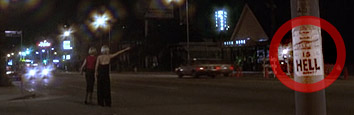
- There is a poster reading "Hollywood is Hell" affixed to a telephone pole. Betty and Rita pass it on their way to Club Silencio.
- At Club Silencio, even Rebekah Del Rio is called "La Llorona de Los Ángeles" — the Crying Lady of the Angels. People who have crossed are often referred to as "angels." Rebekah del Rio sings and falls over, apparently dead, but her voice continues. This signals to Betty and Rita that their bodies are also dead but their voices and spirits are continuing. After they realise they are dead, they have the "key" to moving on in the afterlife, and they both disappear.
- The Cowboy is a spirit entity and part of a lodge. Note when the Cowboy appears to Adam, the electricity in the light overhead dims and flickers — just as televisions and fans alter when a lodge spirit is nearby in Twin Peaks.
- The bum is actually Diane — her corpse, the rot in her soul. "He's the one that's doing this," says the Man With a Dream at the beginning, but it's not a "he" at all (the bum is played by a woman, Bonnie Aarons). Diane is responsible for her own afterlife.
- When people die — or are about to die — or facing some kind of life/death pseudo-state in Lynch films, they're washed with that eerie blue light. It quite reminds one of the "light at the end of the tunnel" — but blue.
As an afterlife experience, Mulholland Drive has no unresolved issues. The Cowboy, the Castigliane Brothers, and Mr. Roque's studio are pieces of Diane that topple Adam and his overbearing control. The Black Book — known as "The History of the World" — is full of the review of Diane's life. Even popular religions indicate a "Book of Life" to be dealt with when we cross over. The phone calls are internal to Diane, alerting various parts of herself to situations that need resolving. David Lynch has never dealt directly with dreams. It's not his style. — smapty / cuttingedgenyc / Alfred Romo